What Are the Top Treatment Plant Types in 2026?

In 2026, choosing a Treatment Plant means matching technology to water quality, local needs, and operating capacity. The strongest option is not always the newest or most automated. It is the one that performs reliably under real conditions.

Dr. Mark van Loosdrecht, a prominent environmental biotechnology researcher, is often associated with the principle, “Wastewater is not a waste, but a resource.” That perspective helps explain why modern facilities increasingly consider resource recovery alongside treatment. Conventional activated-sludge plants remain widely used, while sequencing batch reactors and moving-bed biofilm systems can suit particular flow patterns or site constraints. Membrane bioreactors offer compact treatment and high-quality effluent, though their energy and maintenance demands need careful review. Anaerobic treatment can also recover biogas from suitable wastewater streams.

The categories overlap. A plant may combine processes, and a design that works well for one community may underperform elsewhere. Small package plants can serve remote sites; larger municipal facilities often require more complex process trains. Drinking-water plants face a different set of challenges, including source-water changes and the removal of specific contaminants.

Details matter. A rainy-day flow spike, limited space, or a shortage of trained operators can shape performance as much as equipment specifications. No single type wins everywhere. This overview compares leading Treatment Plant types by application, strengths, trade-offs, and practical fit. Some comparisons remain imperfect; site-specific testing and qualified engineering review are still essential before selecting a system.
What Are the Top Treatment Plant Types in 2026?

How Treatment Plant Types Are Classified in 2026

In 2026, treatment plants are most clearly classified by what they treat, what they remove, and where the treated water goes. This approach is more useful than sorting facilities by size alone. Drinking water plants process river, reservoir, or groundwater for safe use, often through screening, filtration, and disinfection. Wastewater plants treat sewage and used water, reducing solids, organic matter, and pathogens before discharge or reuse. Different purposes.

Industrial treatment plants handle water shaped by specific production processes. Their systems may need to address oils, salts, metals, or other contaminants, so designs vary widely. Desalination plants remove dissolved salts, commonly through membrane or thermal processes, and must manage the concentrated residual stream responsibly. These categories describe a facility’s main task, not every process inside it.

Classification also depends on scale and configuration. Centralized plants serve whole communities, while decentralized systems treat water near homes, campuses, or remote sites. Operators and engineers assess incoming water quality, required output, climate, energy use, and residual management before choosing a suitable category. The boundaries can be messy. An industrial site may reuse wastewater, while a municipal facility may include advanced nutrient removal. Simple charts can miss that overlap.

Municipal Wastewater Treatment Plants and Their Core Processes

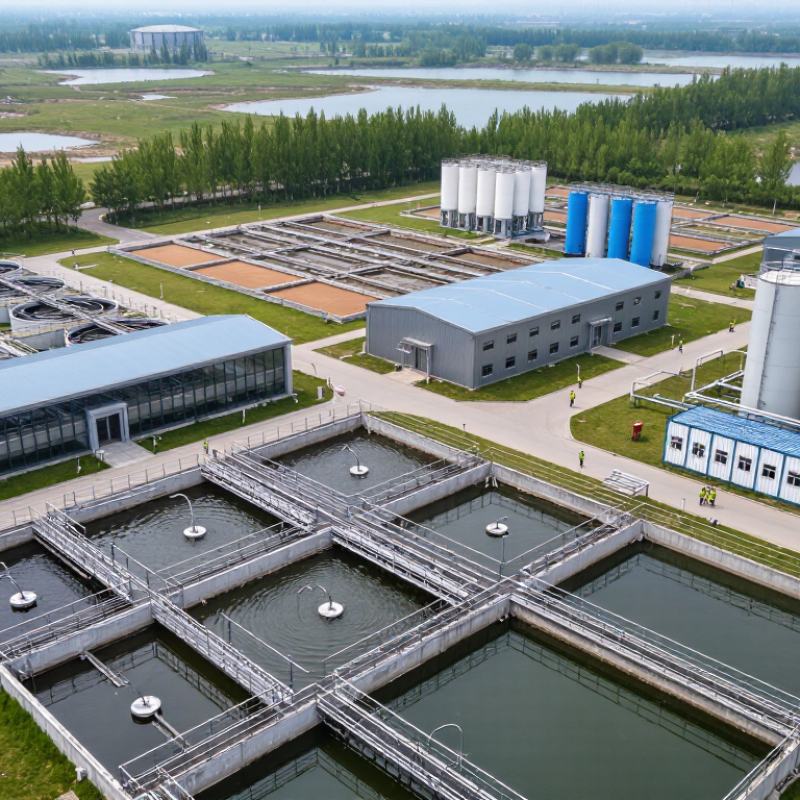
Municipal wastewater treatment plants clean water from homes, businesses, and public facilities before it returns to rivers or other receiving waters. The exact layout varies with local flows, treatment goals, and available land. At the inlet, coarse screens catch wipes, rags, and plastic. Grit channels remove sand and small stones that could wear down pumps. The flow is uneven. Heavy rain can quickly change its volume.

In primary settling tanks, solids sink while oils and grease rise for removal. The wastewater then enters a biological process, often activated sludge. Air supplies oxygen to microorganisms that break down organic material. Operators monitor oxygen, flow, and sludge levels; a brown foam layer or unusual odor can signal a process change. In secondary clarifiers, the biological solids settle, and some are returned to the aeration tanks. The rest moves to solids handling. It takes steady control.

Plants may add nutrient-removal stages to reduce nitrogen or phosphorus, especially where receiving waters are sensitive. Disinfection, using ultraviolet light or carefully controlled chlorine, can reduce pathogens before discharge. Meanwhile, collected solids may be thickened, stabilized, and dewatered. Not every plant uses the same sequence, and performance depends on maintenance and changing influent conditions. A design diagram looks orderly; actual flows are less tidy, and operators must adjust to them.

Drinking Water Treatment Plants for Safe Public Supply

A drinking water treatment plant makes water safer for homes, schools, and public buildings. Its treatment process depends on the source. River water may carry soil and organic matter, while groundwater can contain dissolved minerals. One design does not fit every supply.

At many plants, operators add coagulants so fine particles clump together. The clumps settle in basins, then water passes through filters made with sand, other media, or both. Disinfection helps control disease-causing microbes. Some supplies also need steps to reduce specific chemicals or minerals. Small changes matter. Operators monitor measures such as turbidity, pH, and disinfectant levels, and adjust treatment when raw-water conditions shift. Clear water alone is not proof of safety.

Reliability also depends on maintenance and careful testing. Pumps, valves, filter beds, and dosing equipment all need inspection. A worn seal or poorly calibrated sensor can complicate an otherwise sound process. That is easy to overlook. Plants also keep records and collect samples to check that treatment is working as intended. Public water systems must follow applicable drinking-water requirements, but meeting a standard should not end the conversation. New contaminants, changing weather, and aging infrastructure can expose gaps in existing plans. Operators need to review their data, explain uncertainty plainly, and improve processes where evidence points to a need.

Industrial Treatment Plants for Specialized Waste Streams

Industrial treatment plants are designed around specific waste streams, not a generic wastewater recipe. A metal-finishing facility may need pH adjustment and dissolved-metal removal, while food processing wastewater can contain fats, suspended solids, and changing organic loads. The process train should reflect actual sampling results and production cycles. Wastewater changes.

Equalization tanks help smooth sudden shifts in flow or concentration. Depending on the contaminants, treatment may include oil separation, chemical precipitation, filtration, membrane processes, or biological treatment. Operators commonly track pH, flow, and indicators such as conductivity or organic load. These measurements help reveal when a process is drifting, but they do not replace careful laboratory analysis.

Good design also considers sludge handling, cleaning needs, and the space available for equipment. A treatment step that works well on a small sample may behave differently during a busy production shift. That assumption deserves checking. Pilot testing and ongoing monitoring can expose practical problems before they become routine interruptions. No single plant type suits every specialized stream; the reliable choice is the one supported by site-specific data and realistic operating limits.

Top Industrial Treatment Plant Types for Specialized Waste Streams

Indicative contaminant-removal ranges for common industrial treatment processes

Chemical precipitation is commonly used for dissolved metals, biological treatment for biodegradable organic loads, activated carbon for dissolved organic compounds, and reverse osmosis for dissolved salts. The ranges are indicative engineering benchmarks informed by U.S. EPA wastewater technology fact sheets and standard design references—not guaranteed plant performance. Actual results depend on wastewater composition, system design, and operating conditions.

Decentralized and Advanced Treatment Plants for New Challenges

What Are the Top Treatment Plant Types in 2026?
Decentralized and Advanced Treatment Plants for New Challenges

Decentralized plants treat wastewater close to where it is produced, reducing the need for long sewer networks. The U.S. Environmental Protection Agency reports that more than one in five U.S. households uses onsite wastewater systems. Small can be strategic. Modular units can serve rural communities, housing developments, and facilities that need capacity added in stages. But local operators still need reliable power, trained staff, and a clear maintenance plan.

Advanced treatment adds processes such as membrane filtration, ultraviolet disinfection, and activated carbon to remove finer particles and contaminants. The need is substantial: UN-Water’s 2024 SDG 6 progress update reports that 42% of household wastewater was not safely treated in 2022. These technologies can improve effluent quality for sensitive waterways or planned reuse. They are not interchangeable; the right treatment train depends on incoming water, discharge limits, and the contaminants of concern.

Design decisions should include operating costs, residuals handling, and monitoring from the start. A compact plant may use less land, yet membranes and advanced oxidation can raise energy and maintenance demands. That trade-off deserves honest scrutiny. A practical design often combines dependable biological treatment with targeted polishing, rather than adding every available process. Local water tests and pilot results matter more than an impressive equipment list.

What Are the Top Treatment Plant Types in 2026? — Decentralized and Advanced Treatment Plants for New Challenges

Treatment options range from on-site systems to advanced reuse facilities. The most suitable configuration depends on flow, effluent requirements, site conditions, available operators, and lifecycle costs.

Plant type Typical deployment scale Core treatment approach Best suited to Key planning consideration
On-site septic with advanced treatment Individual homes or small facilities Septic settling followed by soil dispersal; advanced systems may add aerobic treatment, filtration, or disinfection. Low-density areas without a practical connection to a centralized sewer. Soil conditions, groundwater separation, setbacks, inspections, and local approval determine suitability.
Cluster or community decentralized plant Several properties, a village, or a remote site A local collection network feeds a shared plant using processes such as attached growth, batch treatment, or wetlands. Communities where individual systems are unsuitable but a large regional plant is impractical. Long-term responsibility for collection pipes, operation, maintenance, and financing must be clearly assigned.
Package treatment plant Small communities, institutions, camps, and commercial sites Factory-assembled equipment commonly uses extended aeration, sequencing batch treatment, or attached-growth processes. Sites that need a compact, modular plant or a relatively quick installation. Confirm the design matches actual flow variation and that trained operators, power, and spare parts are available.
Sequencing batch reactor (SBR) plant Small to medium wastewater facilities Activated sludge is treated in timed cycles—such as fill, aeration, settling, and decanting—within reactor tanks. Sites with variable flows or limited space for separate treatment stages. Cycle controls and equalization need to be designed for peak loads; automation does not remove the need for skilled oversight.
Moving bed biofilm reactor (MBBR) plant Small to large facilities, including retrofit projects Microorganisms grow on plastic carrier media kept in aerated or mixed tanks; screens retain the carriers. Capacity upgrades or compact biological treatment where additional tank volume is limited. Carrier retention screens, aeration, and downstream solids separation must be properly designed and maintained.
Membrane bioreactor (MBR) plant Small to large facilities where space or effluent quality is a priority Biological treatment is combined with membrane filtration to separate treated water from suspended solids. Compact plants and projects seeking high-quality effluent for further treatment or suitable reuse applications. Membrane fouling control, cleaning, energy use, and replacement planning affect operating costs.
Biological nutrient removal (BNR) plant Municipal and larger institutional or industrial facilities Selected anaerobic, anoxic, and aerobic conditions support biological removal of phosphorus and nitrogen; chemical addition may supplement phosphorus removal. Discharges subject to nutrient limits or located in nutrient-sensitive watersheds. Process control, influent characteristics, chemical supply, and sludge handling influence performance.
Constructed wetland treatment plant Small communities and suitable decentralized sites Water passes through engineered wetland cells where physical, chemical, and biological processes support treatment. Sites with available land and conditions compatible with low-energy treatment and landscape integration. Land area, hydraulic design, climate, vegetation management, and seasonal performance should be assessed.
Advanced water-reuse treatment train Facilities producing water for defined non-potable or potable-reuse applications Builds on secondary treatment with application-specific steps such as filtration, membranes, ultraviolet disinfection, or advanced oxidation. Projects that need a dependable alternative water supply and have an approved reuse pathway. Required barriers depend on the intended use; permits, monitoring, source control, and public-health safeguards are essential.

Selection note: These categories describe common treatment configurations, not a universal ranking. Final design and expected performance should be established through site-specific engineering and applicable local regulations.

CAMaster Logo