
What Is a Truck Engine and What Types Are Available?

A Truck Engine is more than a block of metal beneath the cab. It turns fuel or stored energy into the power that moves heavy loads, climbs grades, and keeps schedules. The right choice depends on payload, distance, terrain, maintenance access, and time spent idling. One detail is easy to miss: the same truck may work very differently across two routes.

The U.S. Environmental Protection Agency’s Inventory of U.S. Greenhouse Gas Emissions and Sinks tracks emissions from medium- and heavy-duty trucks, underscoring their importance in transport planning. The International Energy Agency’s Global EV Outlook 2024 also follows the expanding role of electric trucks. These reports point to a changing landscape, not a single winning design. Diesel remains common for demanding, long-haul work; gasoline and natural-gas engines serve selected applications; battery-electric powertrains can suit predictable routes with charging access. Hydrogen fuel-cell trucks are another developing option. Each has trade-offs.

Mike Roeth, executive director of the North American Council for Freight Efficiency, has emphasized matching vehicle technology to real fleet operations. Put plainly, choose for the duty cycle. That is a paraphrase, not a direct quotation. It matters because a specification sheet cannot show every cold morning, steep ramp, or missed charging window. The categories sound neat. Real fleets are messier. This guide explains how truck engines work, what types are available, and which practical questions help buyers compare them with care.
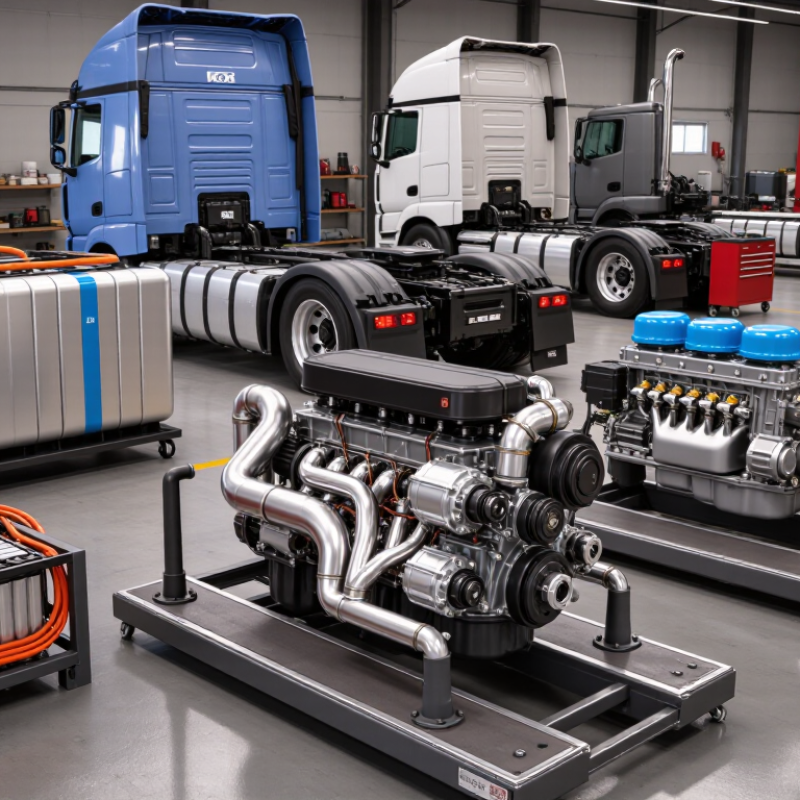
What Is a Truck Engine and What Types Are Available?

Truck Engine Fundamentals: Displacement, Torque, and Power

Engine displacement describes the combined volume swept by an engine’s pistons. It is often measured in liters or cubic inches. A larger displacement can move more air and fuel per cycle, but size alone does not determine how a truck performs. Turbocharging, engine design, and calibration also matter. The number is only one clue.

Torque is twisting force, measured in pound-feet or newton-meters. In a working truck, it helps the engine turn the drivetrain under load. You may notice its effect when pulling away with a loaded trailer or climbing a long grade. Low-speed torque can make those tasks feel less strained. But the transmission and axle gearing shape what reaches the wheels. Numbers can mislead.

Power measures how quickly work is done. It is commonly listed in horsepower or kilowatts, and it is related to torque and engine speed. A truck with strong torque may still feel slow if its gearing or power range does not suit the job. Conversely, more peak power does not automatically mean better towing or lower fuel use. Compare the engine’s output across its operating range, not just its highest figure. Real loads, hills, and shifting habits change the experience. Even careful comparisons have limits.

Truck Engine Fundamentals: Displacement, Torque, and Power

The chart shows typical specification ranges for three truck-engine classes. Displacement is listed in each category; torque and power use separate axes. Larger displacement often supports higher output, but ratings vary by engine design and tuning. Torque helps move heavy loads, while power reflects how quickly work can be done.

How Diesel Engines Deliver Peak Torque at About 1,000–1,500 rpm

A truck diesel is designed to produce strong pulling force at relatively low engine speed. Torque is the twisting force that helps turn the wheels under load. In many heavy-duty engines, peak torque arrives around 1,000–1,500 rpm, though the exact range varies by design. That is the useful zone. A long-stroke layout, precise fuel injection, and turbocharging can help build cylinder pressure without requiring very high rpm. The result is a steady pull when a loaded truck starts moving or climbs a grade.

Picture a trailer moving uphill: the engine may hold near its torque peak while the transmission selects a suitable gear. The truck’s speed still depends on gearing, road conditions, and load, not torque alone. Drivers can watch the tachometer and listen for the engine working smoothly. A very low gear choice can waste fuel; too high a gear may make the engine struggle. The range is a guide, not a promise. Torque curves differ, and altitude, temperature, and maintenance can affect performance. It is a useful rule of thumb, but real driving is less tidy than a chart.

Heavy-Duty Diesel Types: Common Displacements Range from 10 to 16 L

A truck engine converts fuel energy into the torque needed to move heavy loads, climb grades, and maintain speed. In heavy-duty diesel trucks, common displacements range from about 10 to 16 liters. Displacement measures the combined volume swept by the pistons; it does not tell the whole story. Turbocharging, gearing, cooling, and engine calibration also shape how a truck performs. A 13-liter engine, for example, may suit regional hauling, while a larger engine can offer more reserve for sustained heavy loads. Still, liters can mislead.

Engine size is a practical clue, not a guarantee of pulling power or fuel economy. Compare torque curves and the engine’s rated speed with the truck’s actual routes and payload. That detail matters on a long grade, where cooling capacity and transmission gearing can be just as important as displacement. The U.S. Environmental Protection Agency’s 2022 heavy-duty engine rule sets a 0.035 g/bhp-hr nitrogen-oxide standard for model-year 2027 engines, about 80% below the previous standard. The figure shows how emissions requirements shape modern diesel design alongside power needs. Real-world duty cycles vary, though, and a specification sheet cannot predict every operating condition.

What Is a Truck Engine and What Types Are Available? — Heavy-Duty Diesel Types: Common Displacements Range from 10 to 16 L
Engine Type Typical Displacement Common Configuration Typical Applications General Characteristics
Lower-displacement heavy-duty diesel About 10–12 L Inline-six, turbocharged, four-stroke diesel Regional haul, vocational trucks, and lighter highway combinations Often selected where a balance of payload, fuel economy, and performance is important.
Mid-range heavy-duty diesel About 12–14 L Inline-six, turbocharged, four-stroke diesel Long-haul tractors, heavier regional loads, and varied-duty fleets A common size class for trucks that need sustained highway operation and substantial pulling capability.
Large-displacement heavy-duty diesel About 14–16 L Inline-six; some designs use a V-type layout Heavy haul, demanding grades, and high gross-combination-weight applications Greater displacement can support high-load operation, though output and efficiency depend on the full engine and vehicle design.
Inline-six diesel Commonly within the 10–16 L range Six cylinders arranged in one straight bank Highway tractors and many heavy vocational trucks The inline-six layout is widely used in heavy-duty trucks and provides a compact, serviceable arrangement for this class.
V-type diesel Varies by design; some heavy-duty examples fall within the 14–16 L range Usually two cylinder banks arranged in a V Selected heavy-duty or specialized truck applications The V layout can package cylinders in a shorter engine length; availability and use vary by vehicle and engine design.

Displacement ranges and applications are general industry descriptions, not specifications for a particular engine. Actual ratings, configurations, and suitable uses vary by design and vehicle requirements.

Gasoline Truck Engines: Common in Vehicles Rated up to 14,000 lb GVWR

Gasoline truck engines are common in vehicles rated up to 14,000 pounds GVWR. GVWR is the truck’s maximum permitted loaded weight, including passengers and cargo. It is not the engine’s horsepower rating. These engines use spark plugs to ignite a fuel-and-air mixture inside the cylinders. Many deliver responsive acceleration at moderate speeds, which can suit delivery routes, service work, and lighter towing.

A gasoline engine may feel quieter and smoother at idle than some alternatives. At a job site, that can make conversation easier beside the cab. Its power often builds as engine speed rises, so drivers may hear the engine work harder on steep grades or while towing. Actual performance depends on engine size, gearing, axle ratio, and load. The 14,000-pound figure is a useful reference, not a universal dividing line; truck configurations vary.

For a fair comparison, check the truck’s payload and tow ratings, not just its GVWR. A heavy trailer can leave little room for tools, passengers, and supplies. Maintenance also matters: oil condition, cooling-system health, and air-filter cleanliness affect long-term operation. Gasoline engines may fit many everyday work needs, but they are not automatically the best choice for every route. The details can be easy to overlook.

Alternative Truck Powertrains: CNG, Battery-Electric, and Hydrogen

A truck’s powertrain turns stored energy into motion, but it does not always rely on a conventional diesel engine. Compressed natural gas (CNG) engines burn gas in modified combustion systems. They can reduce some tailpipe pollutants compared with older diesel equipment, though actual results depend on engine design and operating conditions. CNG trucks need dedicated fuel tanks and access to refueling stations. Those tanks also take up space and add weight. That matters.

Battery-electric trucks use electric motors powered by onboard battery packs. They are quiet at low speeds and produce no tailpipe emissions while driving. A depot with reliable charging can suit vehicles that return to base each day. Range, payload, weather, and charging time still shape the practical choice. Cold mornings can reduce available range, and large batteries may limit cargo capacity. Real routes tell the story.

Hydrogen trucks commonly use fuel cells to generate electricity for an electric motor; some designs use hydrogen in combustion engines. Fuel-cell vehicles can refuel faster than many battery trucks, but hydrogen supply, station access, and production methods affect cost and emissions. The technology is developing, so performance claims deserve careful checking. I would not treat any one option as a universal replacement. Compare duty cycles, maintenance skills, energy access, and total operating costs before choosing.

CAMaster Logo